


MUX DEMUX &OADM
Company Profile
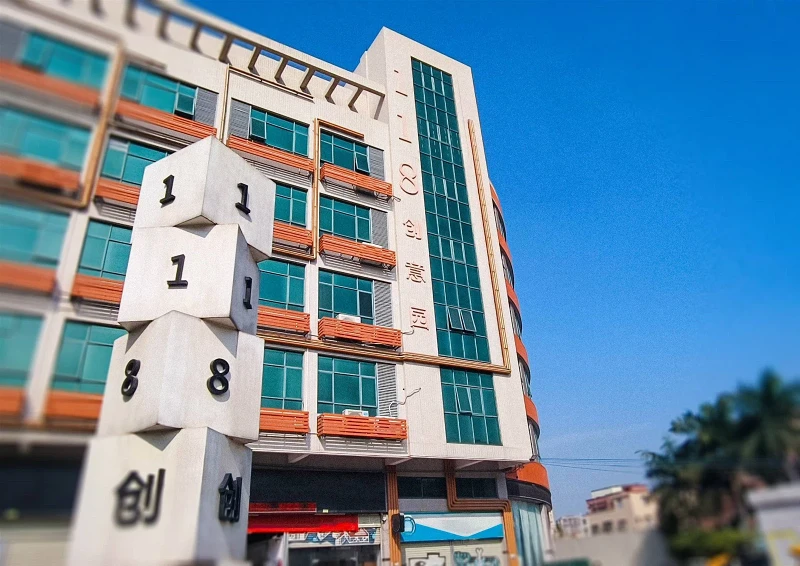
Founded in 2015, D-NET is a leading Chinese high-tech manufacturer and supplier of optical fiber communication solutions, with a factory in Guangdong Province. Our factory produces advanced products serving diverse sectors globally. Driven by exceptional talent, cutting-edge technology, superior equipment, and rigorous management, we've earned the trust of customers worldwide. As a trusted Chinese manufacturer, we prioritize meeting customer needs through professional pre-sale, sale, and after-sales services. Committed to technological innovation and quality management, D-NET stands as a reliable supplier in the industry, dedicated to serving our loyal customer base with unparalleled quality.
Why Choose Us?
Premium Quality
Our products adhere to stringent quality standards, utilizing top-notch materials and sophisticated manufacturing techniques to ensure the highest level of quality and performance.
Extended Warranty
All the products we offer come with a replacement guarantee for 3 months and a comprehensive warranty that spans 3 years, providing consumers with greater peace of mind.
Customized Services
D-NET offers OEM customization services for products. If needed, colored logo labels can be customized.
Integrated Solutions
We offer customers a holistic suite of product solutions and complimentary wavelength division transmission scheme design services, ensuring a one-stop shopping experience.
Products


Products Description

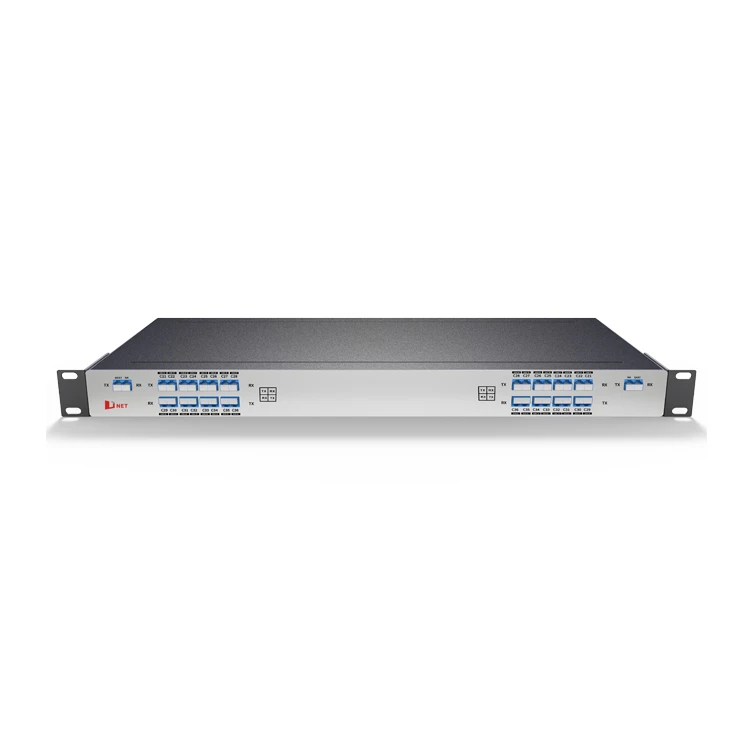
MUX and DEMUX are two key concepts in signal processing, which stand for multiplexer and demultiplexer respectively.
MUX is a device or technology that combines multiple input signals (such as audio, video, data, etc.) into a single output signal. This output signal can be transmitted on a physical medium (such as cable, optical fiber, etc.), thus saving the use of transmission media and improving communication efficiency. In the course of MUX, each input signal is usually assigned a unique identifier (such as a channel number or time slot) so that these signals can be accurately identified and separated at the receiving end.
DEMUX is the inverse process of MUX, and its role is to re-decompose the single signal after MUX merger into the original multiple signal sources. In the process of DEMUX, the receiver will identify and separate the signals according to the identifier of each signal source, and then return them to their original state for subsequent processing or playback.
An Optical Add-Drop Multiplexer (OADM) is a device that enables the division and multiplexing of branch signals in the optical domain. It is one of the key node devices of all-optical network, which has an important impact on the transmission capability, networking mode and key performance of all-optical network.
The main function of OADM is to separate or insert one or more wavelengths from a multi-wavelength channel. Specifically, it can selectively select a wavelength signal from the multiple wavelengths transmitted for downroute (that is, download or remove the wavelength signal to the local), while it can select a new wavelength signal for the road (that is, add to the existing multi-wavelength signal). During this process, other unrelated wavelength channels pass directly through the OADM without being affected.
Advantages of MUX DEMUX &OADM
The Advantages Of MUX DEMUX:
Improve bandwidth utilization:
MUX can combine multiple low-speed signals into one high-speed signal for transmission, thus making full use of the bandwidth resources of the communication channel.
Reduce costs:
By reducing the number of communication channels required, MUX can reduce the cost of infrastructure construction and maintenance.
Enhance network flexibility:
MUX supports a variety of signal formats and rates, giving the network the flexibility to adapt to different business needs.
Simplify network management:
The use of MUX reduces the number of network nodes, thus simplifying the management and monitoring of the network.
Clear signal separation:
DEMUX can clearly distinguish the individual sub-signals in the composite signal, ensuring the accuracy and integrity of the signal.
Improve signal quality:
Through precise filtering and signal processing technologies, DEMUX is able to reduce noise and interference and improve the quality of the signal.
Support multi-service transmission:
DEMUX is capable of processing multiple types of signals, including voice, data and video, and supports multi-service transmission and convergence.
Easy to integrate and extend:
The DEMUX module is easy to integrate with other communication devices and supports extension functions, facilitating network upgrade and expansion.
The Advantages Of OADM:
Increase network flexibility:
OADM can flexibly divide and reuse signals in the optical domain, so that the network can dynamically adjust the signal path and wavelength according to the need.
Enhance network reliability:
OADM supports the transparent transmission of optical signals and can process signals of any format and rate, improving the reliability and stability of the network.
Optimize network resources:
OADM can dynamically allocate and adjust network resources, so that the network can efficiently use wavelength resources, improve transmission efficiency and capacity.
Reduce costs:
By reducing the use of optical amplifiers and Repeaters, OADM is able to reduce the cost of network construction and maintenance.
Supports multiple application scenarios:
The OADM is applicable to various application scenarios, such as trunk and metropolitan area networks, and can meet the requirements of different networks.
Application of MUX DEMUX &OADM
MUX DEMUX:
Data communication:
In data communication networks, MUX is often used to combine data signals from different sources into a single data stream for transmission over shared media such as optical fiber or coaxial cable. This can significantly improve the transmission efficiency and capacity of the network.
Telecommunication network:
In telecommunications networks, MUX is used to convert multiple voice signals (usually analog signals) into digital signals and combine them into a single composite signal for transmission. This helps reduce the number of physical lines required, reduces maintenance costs, and increases the flexibility of the network.
Radio and Television:
In radio and television systems, MUX is used to combine multiple video and audio signals into a single composite signal for broadcast over a single transmission channel. This helps ensure that viewers receive high quality audiovisual content.
Satellite communication:
In satellite communication systems, MUX is used to combine signals from different ground stations into a composite signal for transmission via satellite. This ensures efficient communication between multiple ground stations and meets the growing demand for data transmission.
Optical communication:
In optical communication systems, DEMUX is often used to split WDM (wavelength division multiplexing) signals into multiple optical signals of different wavelengths. This helps to realize the flexible processing and transmission of optical signals and improve the transmission capacity and efficiency of optical communication systems.
OADM:
Metropolitan Area Network (MAN):
The application of OADM in MAN is one of the most important application scenarios. Man is usually used to connect multiple nodes within or between cities to provide high-speed, large-capacity data transmission services. OADM can flexibly partition and reuse optical signals in the MAN, and supports a variety of service transmission, such as voice, data, and video. With OADM, the MAN can be flexibly expanded and upgraded to meet growing business needs.
Long-distance backbone network:
In the long-distance backbone network, OADM also plays an important role. The long-distance backbone network is usually used to connect network nodes between different cities or regions to provide cross-regional data transmission services. OADM can realize the cross-segment transmission of optical signals and the flexible configuration of wavelength channels, and improve the transmission efficiency and capacity of the network. At the same time, OADM can also be used to backup and restore optical signals to improve network reliability and stability.
Data center interconnection:
With the continuous development of cloud computing and big data technology, the volume of data exchange between data centers is growing. OADM can be used for interconnection between data centers to achieve high-speed and large-capacity data transmission. With OADM, the data center can flexibly select the data wavelength channel to be transmitted, improving the efficiency and security of data transmission.
Broadband access:
In the field of broadband access, OADM also has a certain application prospect. Through OADM, operators can provide users with more flexible and efficient broadband access services. For example, operators can dynamically adjust the number and rate of upstream and downstream wavelength channels according to the needs of users and bandwidth resources, so as to provide more personalized broadband access schemes.
Optical network testing and maintenance:
OADM also plays an important role in the testing and maintenance of optical networks.
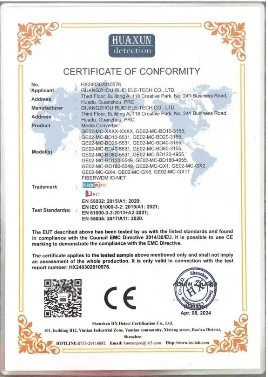
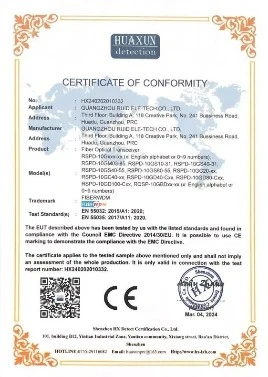
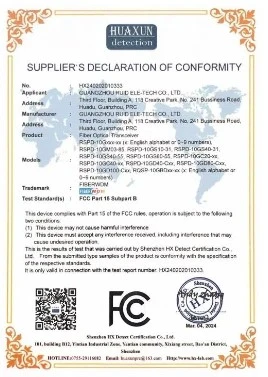
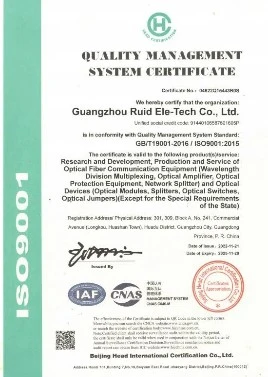
Our certificates

FAQ
Q: What is a MUX and what is its primary function in telecommunications?
Q: How does a MUX differentiate between the various input signals it combines?
Q: What are some common types of MUXes used in modern networks?
Q: What is the role of a DEMUX in a communication system?
Q: How does a DEMUX know which part of the composite signal to extract for each output?
Q: In which layer of the OSI model does a DEMUX operate?
Q: What is an Optical Add-Drop Multiplexer (OADM) used for in optical networks?
Q: How does an OADM differ from a traditional electrical MUX/DEMUX?
Q: What are the key benefits of using OADMs in optical networks?
Q: What technologies are commonly used in OADMs for signal manipulation?
Q: Can a MUX be used to combine signals from different types of media, such as cable and satellite?
Q: Can a DEMUX be used to split a single HDMI signal into multiple displays?
Q: How do OADMs support wavelength division multiplexing (WDM) systems?
Q: Can OADMs be used in conjunction with other optical devices, such as optical amplifiers and regenerators?
We're well-known as one of the leading mux demux &oadm manufacturers and suppliers in China. If you're going to buy high quality mux demux &oadm made in China, welcome to get quotation from our factory.
QSFP-40G-SR4, SFP-10G-BIDI-1550-80