


200G/400G/800G Transceivers
why choose us
D-NET, a top Chinese optical communication product manufacturer since 2015, specializes in R&D, production, and sales of fiber-optic equipment. Our core strength lies in our professional research and development team, who are dedicated to pushing the boundaries of optical communication technology. This highly skilled group continuously launches competitive, high-performance products guided by market needs, covering ten+ series like optical modules, passive devices, CWDM/DWDM systems, and more. Serving diverse industries, we provide comprehensive, customizable solutions and exceptional services as a one-stop supplier, fostering global business growth through our innovative and reliable offerings.
Premium Quality
D-NET is committed to delivering products that embody premium quality, guaranteeing customer satisfaction and setting benchmarks for excellence in every aspect of our offerings.
Customized Services
D-NET, a specialized manufacturer in optical fiber communication, offers OEM customization services, including the provision of colored logo labels, tailored to meet clients' branding and functional requirements.
Extended Warranty
All the products we offer come with a replacement guarantee for 3 months and a comprehensive warranty that spans 3 years, providing consumers with greater peace of mind.
Integrated Solutions
We offer customers a holistic suite of product solutions and complimentary wavelength division transmission scheme design services, ensuring a one-stop shopping experience.
Products


What is a 200G/400G/800G Transceivers
200G transceiver
The 200G transceiver is an Ethernet transceiver with a data transfer rate of 200Gbps (gigabits per second). It is commonly used in network environments that require high bandwidth and low latency, such as data centers and enterprise networks.
400G transceiver
The 400G transceiver is an Ethernet transceiver with a data transfer rate of 400Gbps. It uses advanced modulation technology and multiple optical wavelengths to increase bandwidth on the fiber and is suitable for data centers, enterprise networks and telecommunications systems to improve network capacity and performance.
800G transceiver
The 800G transceiver is an Ethernet transceiver with a data transfer rate of 800Gbps. It is known for its high bandwidth, fast transfer rate and excellent performance, and is suitable for long-distance fiber transmission and next-generation data center, high-performance computing network scenarios.
What Are The Advantages Of 200G/400G/800G Transceivers
200G, 400G, 800G transceivers as high-performance optical communication equipment, each has significant advantages. Here's a breakdown of their advantages:
200G transceiver advantage
High transmission rates: 200G transceivers provide data transmission rates of up to 200Gbps, which can meet the needs of modern data centers and enterprise networks for high-speed data transmission.
Short-range multichannel communications: The 200G Active Cable (AOC) is an eight-channel, pluggable, parallel, fiber QSFP dual-density module for 2x100G Ethernet applications for short-range multichannel data communications and interconnect applications.
High reliability and long life: The 200G transceiver integrates easy-fly technology proven circuitry and VCSEL technology to provide reliable long life, high performance and consistent service.
400G transceiver advantage
Higher transfer rates: 400G transceivers offer transfer rates of up to 400Gbps, four times that of 100G transceivers, enabling significant increases in data center bandwidth and port density.
Multiple packages: 400G transceivers are available in a variety of packages, such as QSFP-DD and OSFP, that provide high-density port configurations and higher data bandwidth.
Advanced modulation technology: The 400G transceiver uses advanced modulation technologies such as PAM4 (Pulse Amplitude modulation Level 4) to enable higher data rates over existing fiber optic infrastructure while improving signal quality.
Long-distance transmission capability: Depending on the specific optical module, the 400G transceiver can support a variety of transmission distances from 100m to tens of kilometers, to meet the needs of different application scenarios.
Low power and low cost: 400G transceivers provide high-speed transmission while focusing on reducing power and cost, using low power design to help save operating costs and protect the environment.
High compatibility and interoperability: 400G transceivers are typically designed to be compatible with devices from a range of vendors, including major switches, routers, and servers, making them practical for multi-vendor interoperability.
800G transceiver advantage
Extremely high transfer rates: The 800G transceiver delivers a transfer rate of 800Gb per second, twice that of the 400G transceiver, which is able to meet the extremely high bandwidth needs of applications such as hyperscale data centers and cloud computing.
Next generation connectors: The 800G transceiver uses a new generation of connectors such as QSFP-DD and OSFP to meet higher bandwidth requirements and transfer rates.
Optimize network resources: The 800G transceiver introduces enhanced spectral efficiency, which optimizes network resources and improves network performance.
High stability and reliability: The 800G transceiver pays attention to stability and reliability during the design and manufacturing process, which can ensure the stability and reliability of the network connection and reduce the failure rate.
Application scenario of 200G/400G/800G Transceivers
200G transceiver
The 200G transceiver is mainly used in the connection between high-performance servers and switches inside the data center, as well as cloud computing, high-performance computing, and large-scale data storage and transmission scenarios requiring high bandwidth and low latency.
400G transceiver
400G transceivers are widely used in modern data centers, cloud computing platforms and high-performance computing environments, providing high-speed and low-latency data transmission channels between servers, storage devices and network devices to meet the needs of increasing data traffic and complex network architectures.
800G transceiver
The 800G transceiver is mainly used in next-generation data centers, high-performance computing, and large-scale cloud computing environments to provide ultra-high-speed, low-latency data transmission capabilities to meet future application scenarios that require extremely high bandwidth.
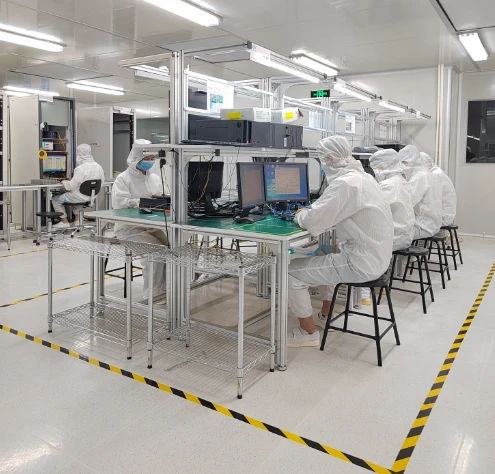
Production and test site

FAQ
Q:1 What are the key differences between 200G, 400G, and 800G transceivers?
Q: 2 How do 200G/400G/800G transceivers enhance network capacity?
Q: 3 What are the challenges associated with deploying 800G transceivers compared to 200G or 400G?
Q: 4 What technologies are leveraged in the development of 200G/400G/800G transceivers?
Q: 5 Are 200G/400G/800G transceivers compatible with existing fiber-optic cables?
Q: 6 Does the 800G optical transceiver support PAM4 modulation technology?
Q: 7 How does the power consumption of 800G optical transceivers compare to that of 400G optical transceivers?
Q:8 What is the main difference between 200G and 400G optical transceivers?
Q: 9 How do 800G optical transceivers compare to 200G and 400G in terms of performance?
Q: 10 What are the benefits of using coherent detection in 400G and 800G optical transceivers?
Q: 11 What does "200G" mean in optical transceivers?
Q: 12 Are 200G, 400G, and 800G optical transceivers used in data centers?
Q: 13 What are the benefits of using higher-speed optical transceivers like 400G and 800G?
We're well-known as one of the leading 200g/400g/800g transceivers manufacturers and suppliers in China. If you're going to buy high quality 200g/400g/800g transceivers made in China, welcome to get quotation from our factory.
SFP-10G-BIDI-1270-10, SFP-10G-CWDM-1470-80, SFP-1G-LR