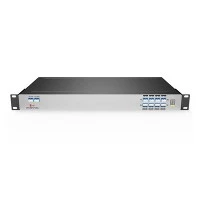
The Difference Between CWDM And DWDM
CWDM and DWDM are key optical communication technologies for expanding bandwidth and distance, using different wavelength channels. However, they have significant differences suitable for various applications.
1.Wavelength spacing and technical realization
The most intuitive difference between CWDM and DWDM is wavelength spacing. The carrier channel spacing of CWDM is wide, with each band usually spaced at 20nm. Therefore, CWDM can only reuse around 8 to 16 wavelengths on the same fiber. In contrast, the carrier channel spacing of DWDM is very narrow, each band may be only 0.2nm, 0.4nm, 0.8nm, or 1.6nm, which enables DWDM to reuse 80 to 160 wavelengths. This "sparse" and "dense" appellation is from this.
In terms of technical realization, CWDM uses uncooled laser for modulation, while DWDM uses cooled laser. The cooled laser achieves precise wavelength control through temperature tuning, while the uncooled laser uses electronic tuning. Because temperature tuning is difficult and expensive to achieve over a wide wavelength range, the cost of DWDM is much higher than CWDM.
2.Application scenario and cost
CWDM and DWDM also differ significantly in terms of application scenarios and costs. CWDM is mainly used in short distance, high bandwidth and dense access point communication, such as metro access layer, enterprise network and campus network. Due to its relatively low cost, CWDM optical modules are widely used, which can greatly save users' network upgrade costs.
DWDM is more suitable for long-distance, large-capacity long-distance backbone networks or large-capacity metropolitan area network core nodes. DWDM optical module can complete long-distance, large-capacity transmission tasks to meet the growing demand for high-speed data transmission. However, due to its high cost and complex technical implementation, DWDM is not widely used in ordinary user homes or small businesses.
3.technical characteristics and development prospects
CWDM and DWDM each have unique technical characteristics and development prospects. CWDM technology has been widely concerned for its low cost, high flexibility and wide application prospects. With the continuous development of network technology and the increasing demand of users, CWDM technology will continue to play an important role in the future.
DWDM technology is favored for its advantages of super-large capacity, ultra-long distance transmission and simple expansion. With the rapid development of emerging technologies such as cloud computing, big data and the Internet of Things, DWDM technology will occupy a more important position in the future optical communication network.
In summary, CWDM and DWDM, key wavelength division multiplexing technologies, differ significantly in wavelength spacing, use cases, cost, and implementation. Users should select the right solution based on needs and budget. As network technology advances and user demands change, CWDM and DWDM will evolve, offering more efficient, reliable, and cost-effective optical communication solutions.