


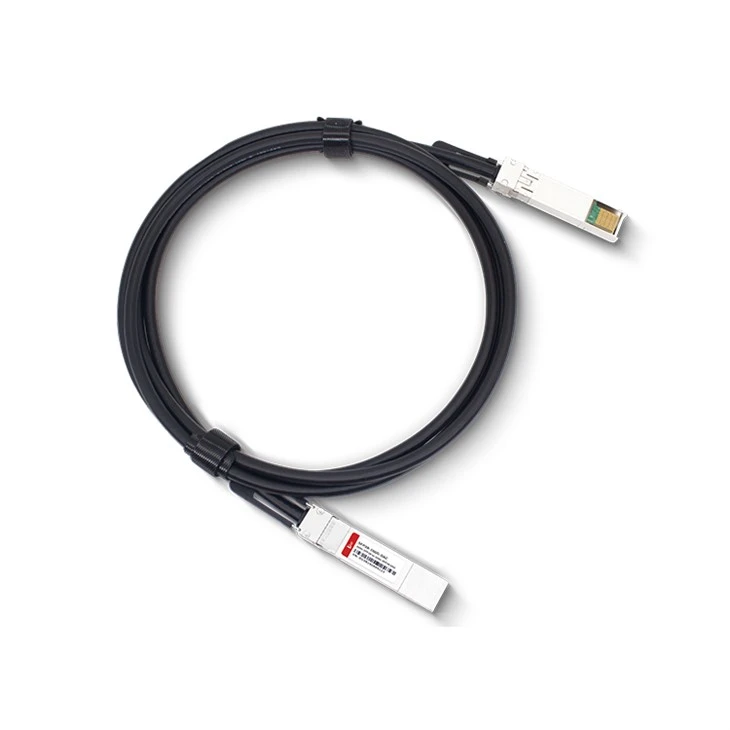
D-net`s Optical Transceiver Module Service
● Compatibility Assistance: D-NET offers compatibility services to ensure optical modules are compatible with equipment from leading manufacturers.
● Personalized Services: D-NET provides OEM customization options for its products. Upon request, customers can have colored logo labels tailored to their needs.
● Standard Delivery Period: 3 Days
● Extensive Shipping Solutions: D-NET collaborates with highly reputable courier companies such as SF, FedEx, DHL, UPS, and others to ensure reliable shipping services.
Features
● Enhanced EMI / EMC performance
● 25Gbps data transfer rate per channel, up to 100Gbps
● Compliant with the IEEE 802.3bj standard and Infiniband EDR specifications
● Meets QSFP + MSA and SFF-8661 / SFF-8665 standards
● Support serial ID function through EEPROM
● 30AWG to 26AWG cable available
● RoHS and halogen-free options
Applications
● Switch / router / HBA / SAN, NIC card
● 40G \ 100G Ethernet
● Storage, switch, data center, network center
● Infiniband, QDR / EDR
Switch / router / HBA / SAN, NIC card
● 40G \ 100G Ethernet
● Storage, switch, data center, network center
● Infiniband, QDR / EDR
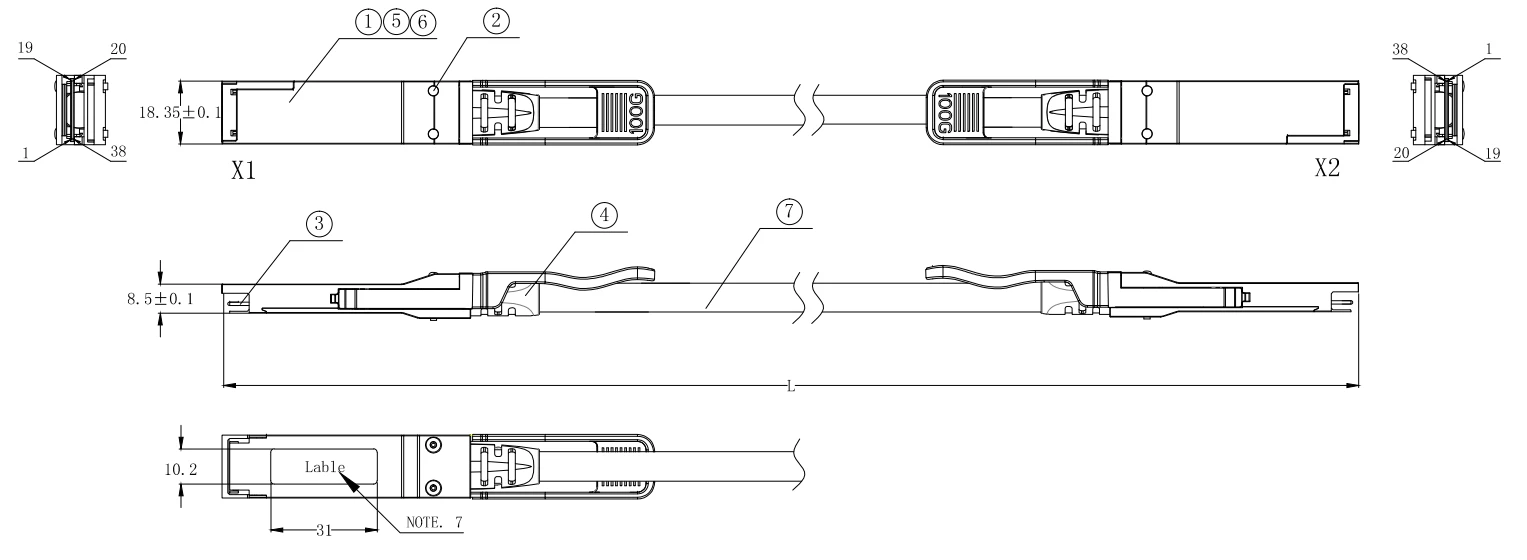
Outline drawing
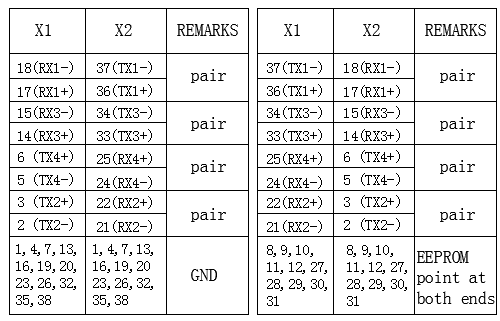
Wiring Diagram
Electrical Performance
Signal Integrity:
|
(ITEM) |
(REQUIREMENT) |
(TEST CONDITION) |
|||||||
|
(Differential Impedance) |
Cable Impedance |
105+5/-10Ω |
Rise time of 25ps (20 % - 80 %). |
||||||
|
Paddle Card Impedance |
100±10Ω |
||||||||
|
Cable Termination Impedance |
100±15Ω |
||||||||
|
[Differential (Input/Output)Return loss SDD11/SDD22] |
Return_loss(f)≥ 16.5-2√f 0.05≤f﹤4.1 10.66-14log10(f/ 5.5) 4.1≤f≤19
Where f is the frequency in GHz Return loss(f) is the return loss at frequency f |
10MHz≤f ≤19GHz |
|||||||
|
[Differential to common-mode (Input/Output)Return loss SCD11/SCD22] |
Return_loss(f)≥ 22-(20/25.78)f 0.01≤f﹤12.89 15-(6/25.78)f 12.89≤f≤19
Where f is the frequency in GHz Return_loss(f) is the Differential to common-mode return loss at frequency f |
10MHz≤f ≤19GHz |
|||||||
|
[Common-mode to Common-mode (Input/Output)Return loss SCC11/SCC22] |
Return_loss(f)≥2dB 0.2≤f≤19 Where f is the frequency in GHz Return_loss(f) is the common-mode to common-mode return loss at frequency f
|
10MHz≤f ≤19GHz |
|||||||
|
[Differential Insertion Loss (SDD21 Max.)] |
(Differential InsertionLoss Max. For TPa to TPb Excluding Test fixture ) |
10MHz≤f ≤19GHz |
|||||||
|
F AWG |
1.25GHz |
2.5GHz |
5.0GHz |
7.0GHz |
10Ghz |
12.89Ghz |
|||
|
30(1m)Max. |
4.5dB |
5.4dB |
6.3dB |
7.5dB |
8.5dB |
10.5dB |
|||
|
30/28(3m)Max. |
7.5dB |
9.5dB |
12.2dB |
14.8dB |
18.0dB |
21.5dB |
|||
|
26(3m)Max. |
5.7dB |
7.2dB |
9.9 dB |
11.9dB |
14.1dB |
16.5dB |
|||
|
26/25(5m)Max. |
7.8dB |
10.0dB |
13.5dB |
16.0dB |
19.0dB |
22.0dB |
|||
|
[Insertion Loss Deviation] |
-0.176*f - 0.7 ≤ ILD ≤ 0.176* f + 0.7 |
50MHz≤f ≤19GHz |
|||||||
|
Differential to common-mode Conversion Loss-Differential Insertion Loss(SCD21-SDD21) |
Conversion _loss(f) – IL(f)≥ 10 0.01≤f﹤ 12.89 27-(29/22)f 12.89≤f﹤15.7
Where f is the frequency in GHz Conversion_loss(f ) is the cable assembly differential to common-mode conversion loss IL(f) is the cable assembly insertion loss |
10MHz≤f ≤19GHz |
|||||||
|
[MDNEXT(multiple disturber near-end crosstalk)] |
≥35dB @12.89GHz |
10MHz≤f ≤19GHz |
|||||||
|
[Intra Skew] |
15ps/m, |
10MHz≤f ≤19GHz |
|||||||
Other Electrical Performance:
|
(ITEM) |
(REQUIREMENT) |
(TEST CONDITON) |
|
[Low Level Contact Resistance] |
70milliohms Max. From initial. |
EIA-364-23:Apply a maximum voltage of 20mV And a current of 100 mA. |
|
Insulation Resistance |
10Mohm(Min.) |
EIA364-21:AC 300V 1minute |
|
[Dielectric Withstanding Voltage] |
NO disruptive discharge. |
EIA-364-20:Apply a voltage of 300 VDC for 1minute between adjacent terminals And between adjacent terminals and ground. |
Environment Performance
|
(ITEM) |
(REQUIREMENT) |
(TEST CONDITON) |
|
[Operating Temp. Range] |
-20°C to +75°C |
Cable operating temperature range. |
|
[Storage Temp. Range (in packed condition)] |
-40°C to +80°C |
Cable storage temperature range in packed condition. |
|
[Thermal Cycling Non-Powered] |
No evidence of physical damage |
EIA-364-32D, Method A, -25 to 90C, 100 cycles, 15 min. dwells |
|
[Salt Spraying] |
48 hours salt spraying after shell corrosive area less than 5%. |
EIA-364-26 |
|
Mixed Flowing Gas |
Pass electrical tests per 3.1 after stressing. (For connector only) |
EIA-364-35 Class II,14 days. |
|
Temp. Life |
No evidence of physical damage |
EIA-364-17C w/ RH, Damp heat 90℃ at 85% RH for 500 hours then return to ambient |
|
Cable Cold Bend |
4H,No evidence of physical damage |
Condition: -20℃±2℃, mandrel diameter is 6 times the cable diameter. |
Mechanical and Physical Characteristics
|
(ITEM) |
(REQUIREMENT) |
(TEST CONDITON) |
|
Vibration |
Pass electrical tests per 3.1 after stressing. |
Clamp & vibrate per EIA-364-28E, TC-VII, test condition letter – D, 15 minutes in X, Y & Z axis. |
|
Twist |
No evidence of physical damage |
Twist cable 180° (±90° from nominal position) for 100 cycles at 30 cycles per minute with a 0.5kg load applied to the cable jacket. Clamp position: 300mm |
|
Cable Flex |
No evidence of physical damage |
Flex cable 180° for 20 cycles (±90° from nominal position) at 12 cycles per minute with a 1.0kg load applied to the cable jacket. Flex in the boot area 90º in each direction from vertical. Per EIA-364-41C |
|
Cable Plug Retention in Cage |
90N Min. No evidence of physical damage |
Force to be applied axially with no damage to cage. Per SFF 8661 Rev 2.1 Pull on cable jacket approximately 1 ft behind cable plug. No functional damage to cable plug below 90N. Per SFF-8432 Rev 5.0 |
|
Cable Retention in Plug |
90N Min. No evidence of physical damage |
Cable plug is fixtured with the bulk cable hanging vertically. A 90N axial load is applied (gradually) to the cable jacket and held for 1 minute. Per EIA-364-38B |
|
Mechanical Shock |
Pass electrical tests Per 3.1 after stressing. |
Clamp and shock per EIA-364-27B, TC-G,3 times in 6 directions, 100g, 6ms. |
|
Cable Plug Insertion |
40N Max.(QSFP28) |
Per SFF8661 Rev 2.1 |
|
Cable plug Extraction |
30N Max. (QSFP28) |
Place axial load on de-latch to de-latch plug.Per SFF8661 Rev 2.1 |
|
Durability |
50 cycles,No evidence of physical damage |
EIA-364-09, perform plug &unplug cycles:Plug and receptacle mate rate: 250times/hour. 50times for QSFP28/SFP28 module (CONNECTOR TO PCB) |
FAQ
1. Can a 100G QSFP28 Passive DAC cable be used interchangeably with other speed ratings, such as 40G or 25G?
A: No, 100G QSFP28 Passive DAC cables are designed specifically for 100Gbps applications and are not compatible with lower speed ratings without appropriate hardware or protocol adjustments.
2. What are the typical applications for 100G QSFP28 Passive DAC cables in data centers?
A: They are commonly used for high-speed inter-rack or intra-rack connections within data centers, enabling low-latency, high-throughput links between servers, storage systems, and networking equipment.
3. Can a 100G QSFP28 Passive DAC cable support multiple protocols or is it specific to a single one?
A: 100G QSFP28 Passive DAC cables are designed to be versatile and can support various networking protocols, including Ethernet, InfiniBand, and others, depending on the equipment and configuration.
4. What is the impedance of a 100G QSFP28 Passive DAC cable, and why is it important?
A: The impedance, typically measured in ohms, is a critical parameter that affects signal reflection and loss. Matching the impedance of the cable to the connected equipment ensures efficient signal transfer and minimizes reflections that can cause signal degradation.
5. How do manufacturers test the performance of 100G QSFP28 Passive DAC cables to ensure quality?
A: D-net conduct a series of rigorous tests, including time-domain reflectometry (TDR) to measure cable impedance and reflections, bit error rate testing (BERT) to evaluate signal integrity, and environmental stress testing to ensure durability under various conditions.
Hot Tags: 100g qsfp28 passive dac direct attach copper cable, China 100g qsfp28 passive dac direct attach copper cable manufacturers, suppliers, factory, SFP-1G-CWDM-1270-40, Mechanical Optical Switch, SFP-10G-BIDI-1270-10, SFP-10G-DWDM-C21-40, QSFP-40G-IR4, SFP-1G-CWDM-1270-80


