


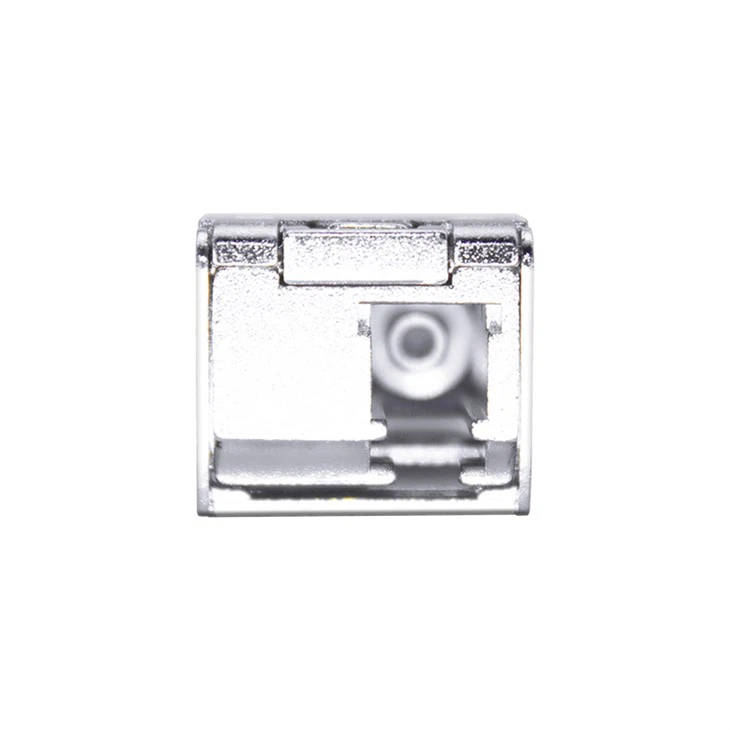
Product Features
● Supports 9.95 to 11.3Gb/s bit rates
● Hot-Pluggable
● Single LC for Bi-directional Transmission
● Cooled EML transmitter, APD photo-detector
● The fiber type is SMF, and the transmission distance can reach 80km
● Temperature Range: 0~ 70°C
Applications
● 10GBASE-ZR/ZW Ethernet
● SONET OC-192 / SDH
● Fibre channel
Product Details
This optical transceiver employs Bidirectional (BiDi) technology, facilitating two-way communication across a single fiber by utilizing distinct wavelengths. Specifically, it operates at a wavelength of 1490nm for transmission and 1550nm for reception, enabling a transmission distance of up to 80 kilometers. The module features LC connectors, which are prevalent in fiber optic networking applications.
Hot Tags: SFP+10G BIDI 1490nm 80KM, China SFP+10G BIDI 1490nm 80KM manufacturers, suppliers, factory, SFP-10G-BIDI-1330-10, SFP-10G-BIDI-1550-80, SFP-10G-BIDI-1490-80, , SFP-10G-BIDI-1270-10
Absolute Maximum Ratings
|
Parameter |
Symbol |
Min. |
Typical |
Max. |
Unit |
|
Storage Temperature |
TS |
-40 |
+85 |
°C |
|
|
Case Operating Temperature |
TA |
0 |
70 |
°C |
|
|
Maximum Supply Voltage |
Vcc |
-0.5 |
4 |
V |
|
|
Relative Humidity |
RH |
0 |
85 |
% |
Electrical Characteristics
(TOP = 0 to 70 °C, VCC = 3.135 to 3.465 Volts)
|
Parameter |
Symbol |
Min. |
Typical |
Max. |
Unit |
Note |
|
Supply Voltage |
Vcc |
3.135 |
3.465 |
V |
||
|
Supply Current |
Icc |
500 |
mA |
|||
|
Power Consumption |
P |
1.8 |
W |
|||
|
Transmitter Section |
||||||
|
Input differential impedance |
Rin |
100 |
Ω |
1 |
||
|
Tx Input Single Ended DC Voltage Tolerance (Ref VeeT) |
V |
-0.3 |
4 |
V |
||
|
Differential input voltage swing |
Vin,pp |
180 |
700 |
mV |
2 |
|
|
Transmit Disable Voltage |
VD |
2 |
Vcc |
V |
3 |
|
|
Transmit Enable Voltage |
VEN |
Vee |
Vee+0.8 |
V |
||
|
Receiver Section |
||||||
|
Single Ended Output Voltage Tolerance |
V |
-0.3 |
4 |
V |
||
|
Rx Output Diff Voltage |
Vo |
300 |
850 |
mV |
||
|
Rx Output Rise and Fall Time |
Tr/Tf |
30 |
ps |
4 |
||
|
LOS Fault |
VLOS fault |
2 |
VccHOST |
V |
5 |
|
|
LOS Normal |
VLOS norm |
Vee |
Vee+0.8 |
V |
5 |
Note
1. Per SFF-8431 Rev 3.0
2. Into 100 ohms differential termination.
3. LOS is an open collector output. Should be pulled up with 4.7k-10 kΩ on the host board. Normal operation is logic 0; loss of signal is logic 1. Maximum pull-up voltage is 5.5V.
Optical Parameters
(TOP = 0 to 70°C, VCC = 3.135 to 3.465 Volts)
|
Parameter |
Symbol |
Min. |
Typical |
Max. |
Unit |
Note |
|
Transmitter Section |
||||||
|
Center Wavelength |
λt |
1490 |
nm |
|||
|
λt |
1550 |
nm |
||||
|
Spectral width |
Δλ |
0.3 |
nm |
|||
|
Average Optical Power |
Pavg |
0 |
+5 |
dBm |
1 |
|
|
Optical Power OMA |
Poma |
-2.1 |
dBm |
|||
|
Laser Off Power |
Poff |
-30 |
dBm |
|||
|
Extinction Ratio |
ER |
8.2 |
dB |
|||
|
Transmitter Dispersion Penalty |
TDP |
3.0 |
dB |
2 |
||
|
Relative Intensity Noise |
Rin |
-128 |
dB/Hz |
3 |
||
|
Optical Return Loss Tolerance |
21 |
dB |
||||
|
Receiver Section |
||||||
|
Center Wavelength |
λr |
1490 |
nm |
|||
|
λr |
1550 |
nm |
||||
|
Receiver Sensitivity |
Sen |
-23 |
dBm |
4 |
||
|
Los Assert |
LOSA |
-34 |
- |
dBm |
||
|
Los Dessert |
LOSD |
-24 |
dBm |
|||
|
Los Hysteresis |
LOSH |
0.5 |
dB |
|||
|
Overload |
Sat |
-7 |
dBm |
5 |
||
|
Receiver Reflectance |
Rrx |
-26 |
dB |
|||
Ordering Information
|
Part Number |
Description |
|
SFP-10GBD80-95 |
10Gb/s 80km BiDi SFP+ Transceiver Hot Pluggable, Single LC, +3.3V, 1490/1550nm EML&APD, Single mode |
FAQ
1. Why use BiDi?
A: The BiDi module can carry data in two directions using a single fiber,The module must be used in pairs, and its biggest advantage is doubling the network capacity and saving fiber resources.
2. What are the advantages of BiDi SFP?
A: BIDI is belong single-fiber bidirectional transceiver, only has 1 port, filtering through the filter in the optical transceiver, and finish the emission and reception at the same time.


