


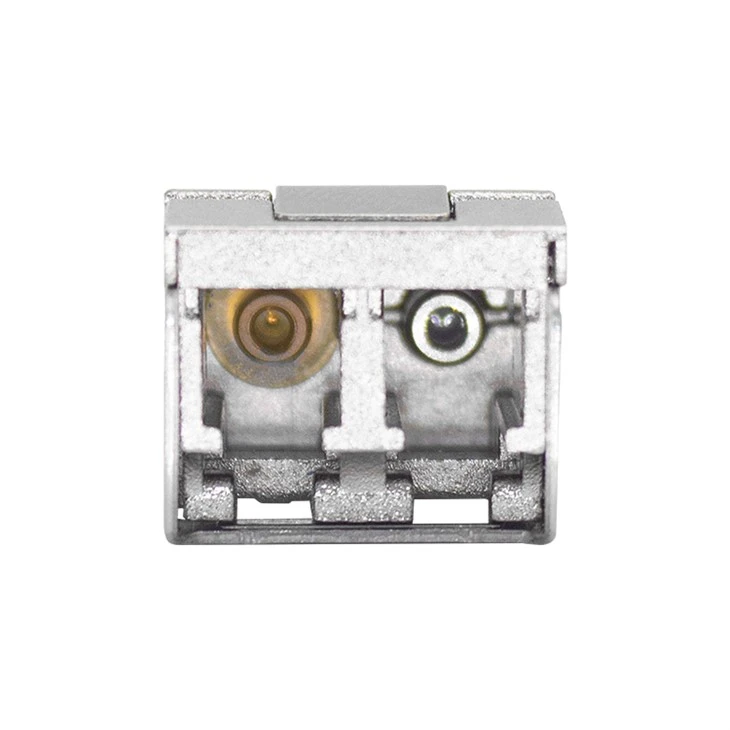
D-net`s Optical Transceiver Module service
----
●Warranty Duration: Enjoy a reassuring three-year warranty for your purchase.
●Compatibility Assurance: D-NET expertise extends to compatibility services, ensuring that our optical modules seamlessly integrate with equipment from leading manufacturers.
●Tailored to Your Needs: Customization is key at D-NET. We offer OEM customization, and if desired, you can personalize your products with colored logo labels.
●Swift Delivery: Expect prompt service with a general delivery time of just 3 days.
●Courier Excellence: Trust in our reliable and high-quality courier partnerships, including SF, FedEx, DHL, UPS, and others, for comprehensive shipping solutions.
Features
● Hot-Pluggable
● 147nm CWDM EML transmitter, APD photo-detector
● Transmission distance is up to 80 km through the SMF connection
● 2-wire interface for management specifications compliant with SFF 8472 digital diagnostic monitoring interface
● RoHS compliant
Applications
● 10GBASE-ZR/ZW Ethernet
● Sonet OC-192/SDH
● 10G Fibre channel
● CWDM Networks
Product Details
This optical transceiver operates at a wavelength of 1470nm specifically within the CWDM spectrum, facilitating efficient multiplexing and demultiplexing of signals in CWDM systems. Boasting a maximum transmission distance of 80 kilometers, it is well-suited for long-haul communication networks where extended reach is a necessity.
Hot Tags: SFP+10G CWDM 1470km 80km, China SFP+10G CWDM 1470km 80km manufacturers, suppliers, factory, SFP-10G-CWDM-1270-10, SFP-10G-CWDM-1470-40, SFP-10G-CWDM-1470-80, SFP-10G-CWDM-1470-40
Absolute Maximum Ratings
|
Parameter |
Symbol |
Min. |
Typical |
Max. |
Unit |
|
Storage Temperature |
TS |
-40 |
+85 |
°C |
|
|
Case Operating Temperature |
TA |
0 |
70 |
°C |
|
|
Maximum Supply Voltage |
Vcc |
-0.5 |
4 |
V |
|
|
Relative Humidity |
RH |
0 |
85 |
% |
Electrical Characteristics
(TOP = 0 to 70 °C, VCC = 3.135 to 3.465 Volts)
|
Parameter |
Symbol |
Min. |
Typical |
Max. |
Unit |
Note |
|
Supply Voltage |
Vcc |
3.135 |
3.465 |
V |
|
Supply Current |
Icc |
600 |
mA |
|||
|
Power Consumption |
P |
2 |
W |
|||
|
Transmitter Section |
||||||
|
Input differential impedance |
Rin |
100 |
Ω |
1 |
||
|
Tx Input Single Ended DC Voltage Tolerance (Ref VeeT) |
V |
-0.3 |
4 |
V |
||
|
Differential input voltage swing |
Vin,pp |
180 |
700 |
mV |
2 |
|
|
Transmit Disable Voltage |
VD |
2 |
Vcc |
V |
3 |
|
|
Transmit Enable Voltage |
VEN |
Vee |
Vee+0.8 |
V |
||
|
Receiver Section |
||||||
|
Single Ended Output Voltage Tolerance |
V |
-0.3 |
4 |
V |
||
|
Rx Output Diff Voltage |
Vo |
300 |
850 |
mV |
||
|
Rx Output Rise and Fall Time |
Tr/Tf |
30 |
ps |
4 |
||
|
LOS Fault |
VLOS fault |
2 |
VccHOST |
V |
5 |
|
|
LOS Normal |
VLOS norm |
Vee |
Vee+0.8 |
V |
5 |
|
Note
1.It is directly connected to the TX data input pins, with AC coupling from the pins into the laser driver IC.
2.The LOS is configured as an open collector output. It should be pulled up with a resistor ranging from 4.7kΩ to 10kΩ on the host board. During normal operation, it outputs a logic 0; in case of signal loss, it outputs a logic
3.The maximum pull-up voltage it can tolerate is 5.5V.
Optical Parameters
(TOP = 0 to 70°C, VCC = 3.135 to 3.465 Volts)
|
Parameter |
Symbol |
Min. |
Typical |
Max. |
Unit |
Note |
|
Transmitter Section |
||||||
|
Center Wavelength |
λc |
λ-6.5 |
λ+6.5 |
nm |
||
|
spectral width |
Δλ |
1 |
nm |
|||
|
Average Optical Power |
Pavg |
0 |
+4 |
dBm |
1 |
|
|
Laser Off Power |
Poff |
-30 |
dBm |
|||
|
Extinction Ratio |
ER |
8.2 |
dB |
|||
|
Transmitter Dispersion Penalty |
TDP |
3.0 |
dB |
2 |
||
|
Relative Intensity Noise |
Rin |
-128 |
dB/Hz |
3 |
||
|
Optical Return Loss Tolerance |
20 |
dB |
||||
|
Receiver Section |
||||||
|
Center Wavelength |
λr |
1260 |
1620 |
nm |
||
|
Receiver Sensitivity (OMA) |
Sen |
-23 |
dBm |
4 |
||
|
Stressed Sensitivity (OMA) |
SenST |
-21 |
dBm |
4 |
||
|
Los Assert |
LOSA |
-34 |
- |
dBm |
||
|
Los Dessert |
LOSD |
-24 |
dBm |
|||
|
Los Hysteresis |
LOSH |
0.5 |
dB |
|||
|
Overload |
Sat |
-7 |
dBm |
5 |
||
|
Receiver Reflectance |
Rrx |
-12 |
dB |
Note
1. Average power figures are informative only, per IEEE802.3ae.
2. 12dB reflection.
3. Conditions of stressed receiver tests per IEEE802.3ae. CSRS testing requires the host board to be SFF-8431 compliant.
4. Receiver overload specified in OMA and under the worst comprehensive stressed condition.
Ordering Information
|
Part Number |
Description |
|
SFP-10GC80-C60 |
10Gb/s 80km CWDM SFP+ Transceiver Hot Pluggable, Duplex LC, +3.3V,1470nm, CWDM EML&APD, Single mode |
FAQ
1. What are 10G SFP+ ports used for?
A: 10G SFP+ usually transmits optical at 850nm, 1310nm, 1550nm, CWDM, DWDM; SONET / SDH for 10Gbps, Fibre Channel, gigabit Ethernet, 10 gigabit Ethernet and other applications, also including DWDM links.
2. Can I use SFP+ transceivers in SFP28 ports?
A: SFP+ (10 Gigabit Ethernet) transceivers cannot be directly used in SFP28 (25 Gigabit Ethernet) ports. Although both SFP+ and SFP28 modules use the same form factor, they operate at different speeds. SFP+ modules support data rates up to 10Gbps, while SFP28 modules support data rates up to 25Gbps. Additionally, SFP28 ports are designed to support higher power levels required for 25Gbps operation. Therefore, using an SFP+ transceiver in an SFP28 port will not be compatible and will not work.


