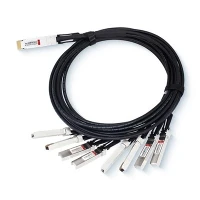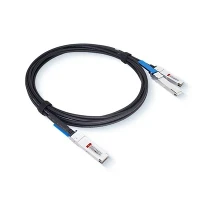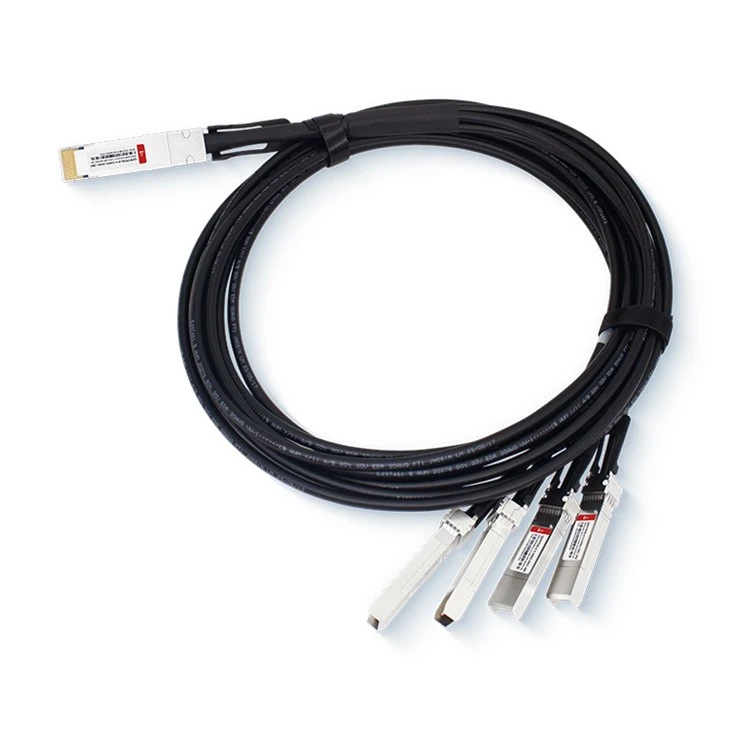
D-Net`S DAC Breakout Cables Service
● Compatibility Assistance: D-NET offers compatibility services to ensure optical modules are compatible with equipment from leading manufacturers.
● Personalized Services: D-NET provides OEM customization options for its products. Upon request, customers can have colored logo labels tailored to their needs.
● Standard Delivery Period: 3 Days
● Extensive Shipping Solutions: D-NET collaborates with highly reputable courier companies such as SF, FedEx, DHL, UPS, and others to ensure reliable shipping services.
Product Features
● MEET SFF-8636 & OSFP MSA
● MEET TO CMIS Rev5.1
● MEET IEEE802.3cd&IEEE802.3 ck
● Support I2C two - line string interface, easy to control
● Support for hot plugging
● Low crosstalk
● Eight-lane electrical interface transmits up to 112Gbps
Applications
● Telecommunications equipment
● Servers ,Routers ,Switches
● Central office ,Cellular infrastructure
● Servers ,Storage
Outline drawing
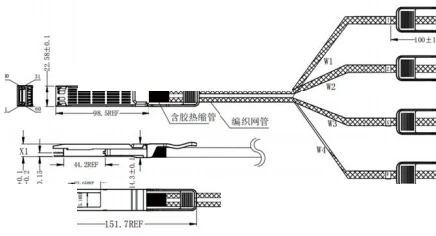
Model comparison table:
|
M.P/N |
C.P/N |
L1(mm) |
AWG |
|
O4O112P-005301-001 |
TBD |
500±15 |
30 |
|
O4O112P-010301-001 |
TBD |
1000±25 |
30 |
|
O4O112P-015281-001 |
TBD |
1500±30 |
28 |
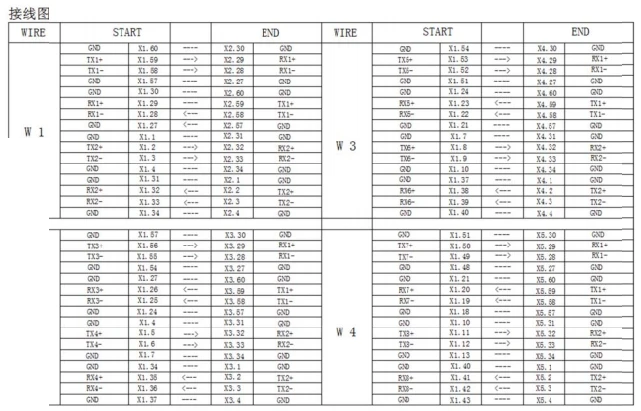
Wiring Diagram
Electrical Performance
Signal Integrity:
|
(ITEM) |
(REQUIREMENT) |
(TEST CONDITION) |
||
|
(Differe ntial Impedan ce)
|
Cable Impedance |
100±5Ω |
Rise time of 25ps (20 % - 80 %).
|
|
|
Paddle Card Impedance |
100±10Ω |
|||
|
Cable Termination Impedance |
100±10Ω |
|||
|
[Differential (Input/Output)Return loss SDD11/SDD22] |
Return_loss(f)≥16.5-2√f 0.05≤f﹤4.1 10.66-14log10(f/ 5.5) 4.1≤f≤40 Where f is the frequency in GHz Return loss(f) is the return loss at frequency f |
10MHz≤f ≤40GHz |
||
|
[Differential to common-mode (Input/Output)Return loss SCD11/SCD22] |
Return_loss(f)≥22- 10(f/26.56) 0.05≤f﹤26.56 15-3(f/26.56) 26.56≤f≤40
|
50MHz=f =40GHz |
|||||
|
[Common-mode to Common-mode (Input/Output)Return loss SCC11/SCC22] |
Return_loss(f)≥1.8dB 0.05≤f≤40 Where f is the frequency in GHz Return_loss(f) is the common-mode to common-mode return loss at frequency f
|
50MHz=f =40GHz |
|||||
|
[Differential Insertion Loss (SDD21 Max.)] |
(Differential InsertionLoss Max. For TPa to TPb Excluding Test fixture ) Insertion _loss(f) ≥-19.75dB 0.05≤f≤26.56 Where f is the frequency in GHz Insertion Loss (f) Differential Insertion Loss at frequency f |
50MHz=f =40GHz |
|||||
|
[Insertion Loss Deviation] |
-0.176*f - 0.7 ≤ ILD ≤ 0.176* f + 0.7 |
50MHz≤f ≤ 26.56GHz |
|||||
|
Differential to common-mode Conversion Loss-Differential Insertion Loss(SCD21-SDD21) |
Conversion _loss(f) – IL(f)≥10 0.05≤f < 12.89 14-0.3108f 12.89≤f﹤40 Where f is the frequency in GHz Conversion_loss(f ) is the cable assembly differential to common-mode conversion loss IL(f) is the cable assembly insertion loss
|
50MHz≤f ≤ 40GHz |
|||||
|
[MDNEXT(multiple disturber near-end crosstalk)] |
≥35dB @26.5GHz |
10MHz=f =26.5GHz |
|||||
|
[Intra Skew] |
10ps/m, |
10MHz=f =26.5GHz |
|||||
Other Electrical Performance:
|
(ITEM) |
(REQUIREMENT) |
(TEST CONDITON) |
|
[Low Level Contact Resistance] |
20milliohms Max. From initial. |
EIA-364-23:Apply a maximum voltage of 20mV And a current of 100 mA. |
|
Insulation Resistance |
10Mohm(Min.) |
EIA364-21:AC 300V 1minute |
|
[Dielectric Withstanding Voltage] |
NO disruptive dischharge. |
EIA-364-20:Apply a voltage of 300 VDC for 1minute between adjacent terminals And between adjacent terminals and ground. |
Environment Performance
|
(ITEM) |
(REQUIREMENT) |
(TEST CONDITON) |
|
[Operating Temp. Range] |
0°C to +70°C |
Cable operating temperature range. |
|
[Storage Temp. Range (in packed condition)] |
-40°C to +85°C |
Cable storage temperature range in packed condition. |
|
[Thermal Cycling Non-Powered] |
No evidence of physical damage |
EIA-364-32D, Method A, -25 to 90C, 100 cycles, 15 min. dwells |
|
[Salt Spraying] |
48 hours salt spraying after shell corrosive area less than 5%. |
EIA-364-26 |
|
Mixed Flowing Gas |
Pass electrical tests per 3.1 after stressing. (For connector only) |
EIA-364-35 Class II,14 days. |
|
Temp. Life |
No evidence of physical damage |
EIA-364-17C w/ RH, Damp heat 90℃ at 85% RH for 500 hours then return to ambient |
|
Cable Cold Bend |
4H,No evidence of physical damage |
Condition: -20℃±2℃ , mandrel diameter is 6 times the cable diameter. |
Mechanical and Physical Characteristics
|
(ITEM) |
(REQUIREMENT) |
(TEST CONDITON) |
|
Vibration |
Pass electrical tests per 3.1 after stressing. |
Clamp & vibrate per EIA-364-28E, TC-VII, test condition letter – D, 15 minutes in X, Y & Z axis. |
|
Cable Flex |
No evidence of physical damage |
Flex cable 180° for 20 cycles (±90° from nominal position) at 12 cycles per minute with a 1.0kg load applied to the cable jacket. Flex in the boot area 90º in each direction from vertical. Per EIA-364-41C |
|
Cable Plug Retention in Cage |
90N Min. No evidence of physical damage |
Force to be applied axxially with no damage to cage. Per SFF 8661 Rev 2.1 Pull on cable jacket approximately 1 ft behind cable plug. No functional damage to cable plug below 90N. Per SFF-8432 Rev 5.0 |
|
Cable Retention in Plug |
90N Min. No evidence of physical damage |
Cable plug is fixtured with the bulk cable hanging vertically. A 90N axial load is applied (gradually) to the cable jacket and held for 1 minute. Per EIA-364-38B |
|
Mechanical Shock |
Pass electrical tests Per 3.1 after stressing. |
Clamp and shock per EIA-364-27B, TC-G,3 times in 6 directions, 100g, 6ms. |
|
Cable Plug Insertion |
40N Max.(QSFP112) 40N Max.(55N) OS FP) |
Per QSFP112_MSA _Rev2.1.1 Per OSFP _Specification_Rev5_0 |
|
Cable plug Extraction |
30N Max. (QSFP112) 30N Max. (45N) OS FP |
Per OSFP _Specification_Rev5_0 Measure without the aid of any cage kick-out springs. Place axial load on de-latch to de-latch pllug. Per QSFP112_MSA _Rev2.1.1 |
|
Durability |
50 cycles,No evidence of physical damage |
EIA-364-09, perform pplug &unplug cycles:Plug and receptacle mate rate: 250times/hour. 50times for QSFP28/SFP28 module (CONNECTOR TO PCB) |
Package diagram
Both ends of the connector use protective sleeve protection, each into a separate anti - static bag.
<=2m : 200mm*300mm
>2m: 300mm*400mm
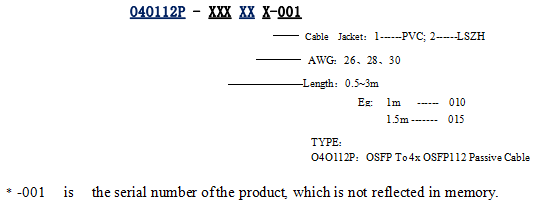
Product number explain
FAQ
1. What connector types are used on both ends of the cable?
A: One end of the cable features an OSFP connector, designed for high-speed optical and copper interfaces, while the other end has four QSFP112 connectors, each capable of 200Gbit/s data rates.
2. What is the purpose of the breakout feature in this cable?
A: The breakout feature allows a single high-speed OSFP interface to be split into four lower-speed QSFP112 interfaces, providing flexibility in network configurations and enabling the use of existing 200G infrastructure.
3. How does this cable handle signal integrity and EMI/RFI interference?
A: The cable is designed with shielding and impedance-controlled construction to maintain signal integrity and reduce electromagnetic interference (EMI) and radio frequency interference (RFI).
4. Can this cable be used for both transmit and receive applications?
A: Yes, this DAC cable is bidirectional, meaning it can be used for both transmit and receive applications, depending on the system configuration.
Hot Tags: 800g osfp to 4x 200g qsfp112 breakout dac direct attach copper cable, China 800g osfp to 4x 200g qsfp112 breakout dac direct attach copper cable manufacturers, suppliers, factory, QSFP-40G-ER4, dac breakout cable for audio recording production, SFP28-DWDM-C21, SFP-10G-ER, QSFP28-100G-ER4, SFP-10G-CWDM-1470-80