


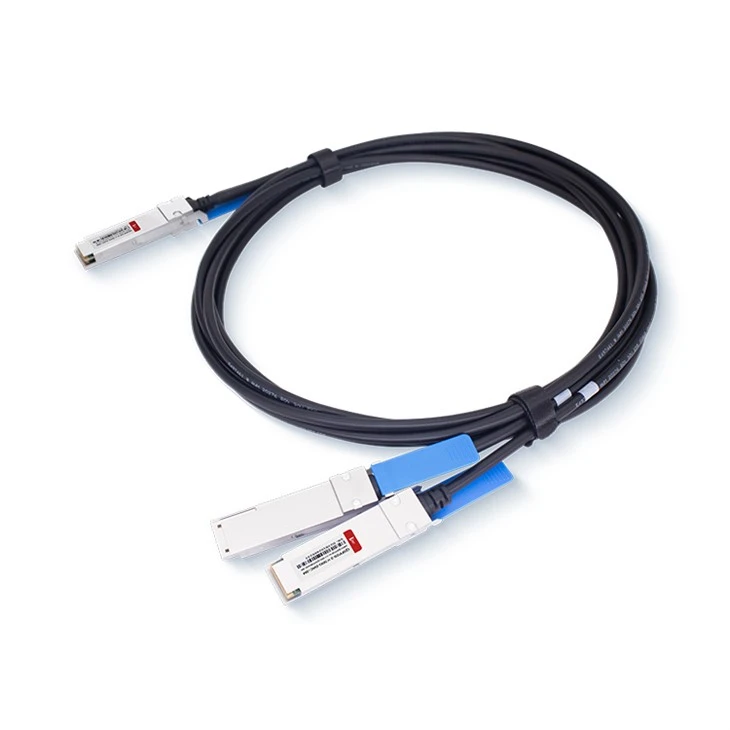
D-Net`S DAC Breakout Cables Service
● Compatibility Assistance: D-NET offers compatibility services to ensure optical modules are compatible with equipment from leading manufacturers.
● Personalized Services: D-NET provides OEM customization options for its products. Upon request, customers can have colored logo labels tailored to their needs.
● Standard Delivery Period: 3 Days
● Extensive Shipping Solutions: D-NET collaborates with highly reputable courier companies such as SF, FedEx, DHL, UPS, and others to ensure reliable shipping services.
Product Features
● MEET SFF-8432& OSFP MSA
● MEET IEEE802.3bj&IEEE802.3 cd
● Support I2C two - line string interface, easy to control
● Support for hot plugging
● Low crosstalk
● Eight-lane electrical interface transmits up to 28Gbps NRZ or 56Gbps PAM-4
Applications
● Telecommunications equipment
● Servers ,Routers ,Switches
● Central office ,Cellular infrastructure
● Servers ,Storage
Outline drawing
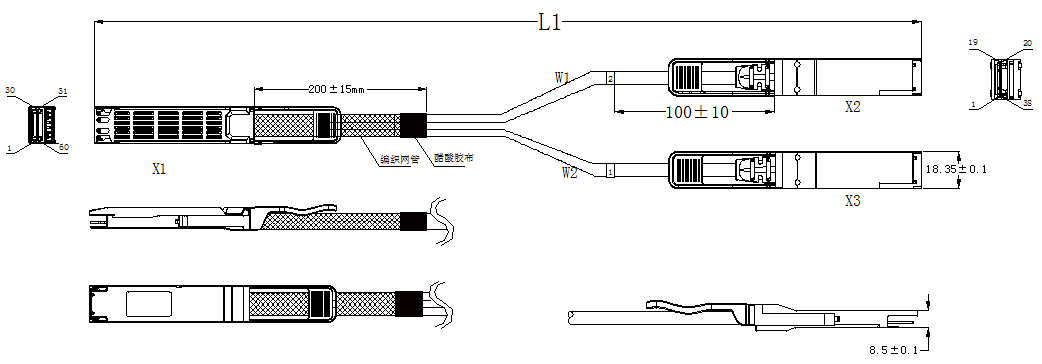
Model comparison table:
|
M.P/N |
C.P/N |
L(mm) |
AWG |
|
O2QS56P-005301-001 |
TBD |
500±15 |
30 |
|
O2QS56P-010301-001 |
TBD |
1000±25 |
30 |
|
O2QS56P-015301-001 |
TBD |
1500±30 |
30 |
|
O2QS56P-020281-001 |
TBD |
2000±35 |
28 |
|
O2QS56P-025281-001 |
TBD |
2500±35 |
28 |
|
O2QS56P-030271-001 |
TBD |
3000±45 |
27 |
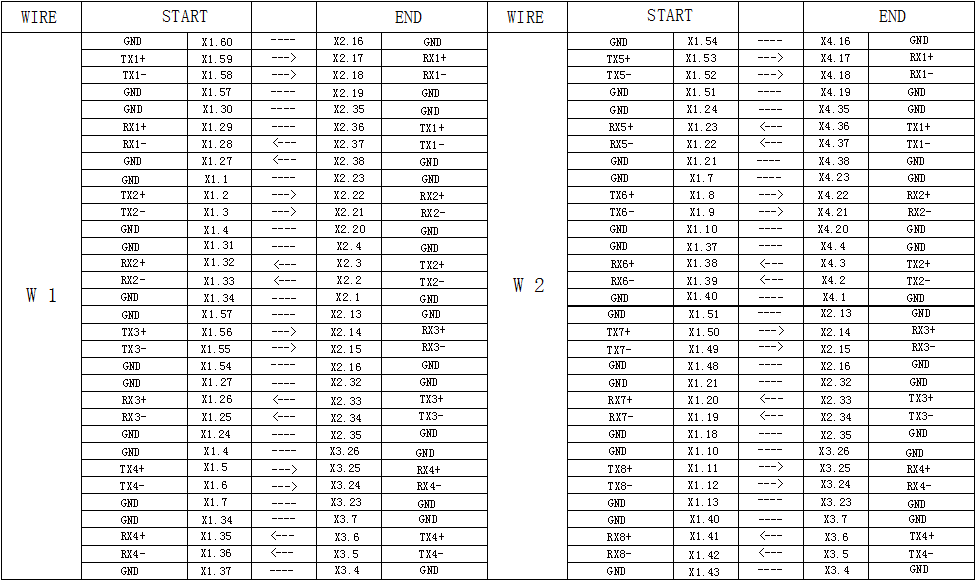
Wiring Diagram
Electrical Performance
Signal Integrity:
|
ITEM |
REQUIREMENT |
TEST CONDITION |
|
|
(Differential Impedance)
|
Cable Impedance |
100±5Ω |
Rise time of 25ps (20 % - 80 %).
|
|
Paddle Card Impedance |
100±10Ω |
||
|
Cable Termination Impedance |
100+10/-15Ω |
||
|
[Differential (Input/Output)Return loss SDD11/SDD22] |
Return_loss(f)≥16.5-2√f 0.05≤f﹤4.1 10.66-14log10(f/ 5.5) 4.1≤f≤19 Where f is the frequency in GHz Return loss(f) is the return loss at frequency f
|
10MHz≤f ≤26.5GHz |
|
|
[Differential to common-mode (Input/Output)Return loss SCD11/SCD22] |
Return_loss(f)≥ 22-10(f/25.78) 0.05≤f﹤12.89 15-(6/25.78)f 12.89≤f≤19 Where f is the frequency in GHz Return_loss(f) is the Differential to common-mode return loss at frequency f
|
50MHz≤f ≤26.5GHz |
|
|
[Common-mode to Common-mode (Input/Output)Return loss SCC11/SCC22] |
Return_loss(f)≥2dB 0.05≤f≤19 Where f is the frequency in GHz Return_loss(f) is the common-mode to common-mode return loss at frequency f
|
50MHz≤f ≤26.5GHz |
|
[Differential Insertion Loss (SDD21 Max.)] |
(Differential InsertionLoss Max. For TPa to TPb Excluding Test fixture |
50MHz≤f ≤26.5GHz |
|
Insertion _loss(f)≥-17.16dB 0.05≤f≤13.28GHz Where f is the frequency in GHz Insertion Loss (f) Differential Insertion Loss at frequency f |
||
|
[Insertion Loss Deviation] |
-0.176*f - 0.7 ≤ ILD ≤ 0.176* f + 0.7 |
50MHz≤f ≤26.56GHz |
|
Differential to common-mode Conversion Loss-Differential Insertion Loss(SCD21-SDD21) |
Conversion _loss(f) – IL(f)≥10 0.05≤f﹤12.89 14-0.3108f 12.89≤f﹤26.5 Where f is the frequency in GHz Conversion_loss(f ) is the cable assembly differential to common-mode conversion loss IL(f) is the cable assembly insertion loss
|
50MHz≤f ≤26.5GHz |
|
[MDNEXT(multiple disturber near-end crosstalk)] |
≥35dB @26.5GHz |
10MHz≤f ≤26.5GHz |
|
[Intra Skew] |
10ps/m, |
10MHz≤f ≤19GHz |
Other Electrical Performance
|
ITEM |
REQUIREMENT |
TEST CONDITON |
|
[Low Level Contact Resistance] |
20milliohms Max. From initial. |
EIA-364-23:Apply a maximum voltage of 20mV And a current of 100 mA. |
|
Insulation Resistance |
10Mohm(Min.) |
EIA364-21:AC 300V 1minute |
|
[Dielectric Withstanding Voltage] |
NO disruptive discharge. |
EIA-364-20:Apply a voltage of 300 VDC for 1minute between adjacent terminals And between adjacent terminals and ground. |
Environment Performance
|
ITEM |
REQUIREMENT |
TEST CONDITON |
|
[Operating Temp. Range] |
0°C to +70°C |
Cable operating temperature range. |
|
[Storage Temp. Range (in packed condition)] |
-40°C to +85°C |
Cable storage temperature range in packed condition. |
|
[Thermal Cycling Non-Powered] |
No evidence of physical damage |
EIA-364-32D, Method A, -25 to 90C, 100 cycles, 15 min. dwells |
|
[Salt Spraying] |
48 hours salt spraying after shell corrosive area less than 5%. |
EIA-364-26 |
|
Mixed Flowing Gas |
Pass electrical tests per 3.1 after stressing. (For connector only) |
EIA-364-35 Class II,14 days. |
|
Temp. Life |
No evidence of physical damage |
EIA-364-17C w/ RH, Damp heat 90℃ at 85% RH for 500 hours then return to ambient |
|
Cable Cold Bend |
4H,No evidence of physical damage |
Condition: -20℃±2℃, mandrel diameter is 6 times the cable diameter. |
Mechanical and Physical Characteristics
|
ITEM |
REQUIREMENT |
TEST CONDITON |
|
Vibration |
Pass electrical tests per 3.1 after stressing. |
Clamp & vibrate per EIA-364-28E, TC-VII, test condition letter – D, 15 minutes in X, Y & Z axis. |
|
Cable Flex |
No evidence of physical damage |
Flex cable 180° for 20 cycles (±90° from nominal position) at 12 cycles per minute with a 1.0kg load applied to the cable jacket. Flex in the boot area 90º in each direction from vertical. Per EIA-364-41C |
|
Retention in Cage |
120N Min (OSFP) 90N Min (QSFP) No evidence of physical damage |
No functional damage to module, connector, or cage with latching mechanism activated. . Per OSFP _Specification_Rev5 Pull on cable jacket approximately 1 ft behind cable plug. No functional damage to cable plug below 90N. Per SFF-8432 Rev 5.0 |
|
Cable Retention in Plug |
90N Min. No evidence of physical damage |
Cable plug is fixtured with the bulk cable hanging vertically. A 90N axial load is applied (gradually) to the cable jacket and held for 1 minute. Per EIA-364-38B |
|
Mechanical Shock |
Pass electrical tests Per 3.1 after stressing. |
Clamp and shock per EIA-364-27B, TC-G,3 times in 6 directions, 100g, 6ms. |
|
Cable Plug Insertion |
40N Max.(QSFP56) 40N Max.(55N) OSFP |
Per SFF8661 Rev 2.1 Module to be inserted into connector and cage with latch mechanism engaged. (55N if the cage has riding heatsink) Per OSFP _Specification_Rev5 |
|
Cable plug Extraction |
30N Max. (QSFP56) 30N Max. (45N) OSFP |
Measure without the aid of any cage kick-out springs. Place axial load on de-latch to de-latch plug. Per SFF-8432 Rev 5.0 Module to be removed from connector and cage with latching mechanism disengaged. (45N if the cage has riding heatsink) Per OSFP _Specification_Rev5_0 5.0 |
|
Durability |
50 cycles,No evidence of physical damage |
EIA-364-09, perform plug &unplug cycles:Plug and receptacle mate rate: 250times/hour. 50times for QSFP28/SFP28 module (CONNECTOR TO PCB) |
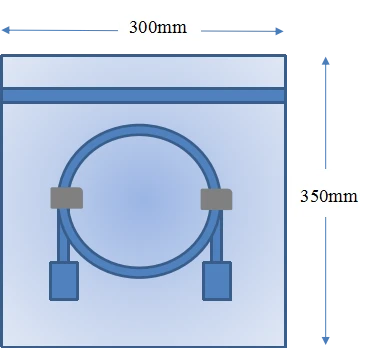
Package diagram
Both ends of the connector use protective sleeve protection, each into a separate anti - static bag.
<=2m : 200mm*300mm
>2m: 300mm*400mm
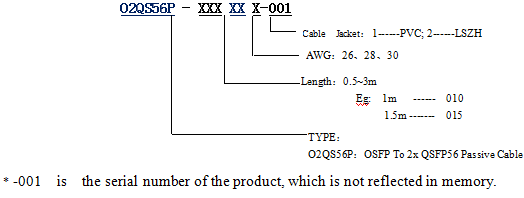
Product number explain
FAQ
1. Is this cable compatible with existing equipment?
A: Yes, this cable is backward compatible with existing QSFP+/QSFP28 equipment, allowing for easy upgrades to higher data rates without the need to replace all existing equipment.
2. What are the key features of this cable?
A: Key features include its support for multiple data rates, backward compatibility with 100G and 200G Ethernet networks, low power consumption, and excellent signal integrity. It also supports hot-plugging and has a low insertion loss and low crosstalk.
3. Is this cable RoHS compliant?
RoHS (Restriction of Hazardous Substances) compliance ensures that the cable contains no harmful substances, which is important for environmental and safety reasons.
Hot Tags: 400g osfp to 2xqsfp56 passive breakout dac direct attach copper cable, China 400g osfp to 2xqsfp56 passive breakout dac direct attach copper cable manufacturers, suppliers, factory, SFP-10G-BIDI-1490-80, SFP-10G-LR, QSFP28-100G-SR4, dac breakout cable for audio processing production, SFP28-25G-LR, QSFP56-2X100G-AOC


