


D-net`s Mechanical Optical Switch service
●Compatibility Assistance: D-NET offers compatibility services to ensure optical modules are compatible with equipment from leading manufacturers.
●Personalized Services: D-NET provides OEM customization options for its products. Upon request, customers can have colored logo labels tailored to their needs.
●Standard Delivery Period: 3 Days
● Extensive Shipping Solutions: D-NET collaborates with highly reputable courier companies such as SF, FedEx, DHL, UPS, and others to ensure reliable shipping services.
Features
● Minimal loss during insertion
● Stable signal quality
● Quick switching
● Wide wavelength coverage
● Energy-efficient
● Durable and compact design
Applications
● Network Testing and Monitoring
● Fiber Optic Network Redundancy
● Optical Signal Routing
Hot Tags: 2X2 OPTO Mechanical Optical Switch, China 2X2 OPTO Mechanical Optical Switch manufacturers, suppliers, factory, Mechanical Optical Switch, , , , Mechanical Optical Switch
Specifications
|
Operating Wavelength |
1260~1620nm (SM) 850nm(MM) |
Insertion Loss |
≤1.0dB |
|
Wavelength Dependent Loss |
≤0.25dB |
Polarization Dependent Loss |
≤0.05dB |
|
Temperature Dependent Loss |
≤0.20dB |
Return Loss |
SM≥50dB MM≥30dB |
|
Cross Talk |
SM≥55dB MM≥35dB |
Switch Time |
≤8ms |
|
Repeatability |
≤±0.02dB |
Durability |
≥107 times |
|
Operating Voltage |
3 or 5V |
Switch Type |
Non-Latching/Latching |
|
Operating Temperature |
-20~+70℃ |
Storage Temperature |
-40~+85℃ |
|
Optical Power |
≤500mW |
Dimension |
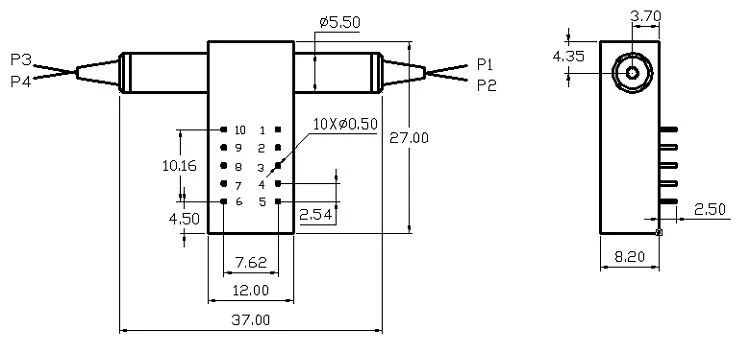
27.0L×12.0W×8.2H mm |
Pin Configurations
|
Type |
Optical Route |
Electric Drive |
State Sensor |
||||||
|
2×2B |
Pin 1 |
Pin 5 |
Pin 6 |
Pin 10 |
Pin 2-3 |
Pin 3-4 |
Pin 7-8 |
Pin 8-9 |
|
|
Latching |
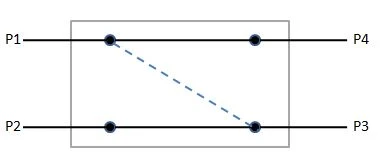
P1-P3 |
-- |
-- |
GND |
V+ |
Close |
Open |
Open |
Close |
|
P1-P4,P2-P3 |
V+ |
GND |
-- |
-- |
Open |
Close |
Close |
Open |
|
|
Non-latching |
P1-P3 |
-- |
-- |
-- |
-- |
Close |
Open |
Open |
Close |
|
P1-P4,P2-P3 |
V+ |
-- |
-- |
GND |
Open |
Close |
Close |
Open |
|
Mechanical Dimensions (Unit:mm)
Optical Route
Ordering Information
|
FSW |
-2X2B- |
-Wavelength- |
-Switch Type- |
-Voltage- |
-Fiber Type- |
-Package- |
-Fiber length- |
-Connector- |
|
1060=1 C+L=2 1310=3 1410=4 1550=5 650=6 780=7 1260-1610=A 1310/1550=9 850=8 Special=0 |
Latching=1 Non-latching=2 MINI Latching=3 MINI Non-latching=4 Special=0 |
3V=3 5V=5 Special=0 |
SM28=1 50/125=5 62.5/125=6 Special=0 |
Bare fiber=1 900um tube=3 Special=0 |
0.25m=1 0.5m=2 1.0m=3 Special=0 |
None=1 FC/PC=2 FC/APC=3 SC/PC=4 SC/APC=5 ST/PC=6 LC/PC=7 Duplex LC=8 Special=0 |
FAQ
1. What is optical bypass switch?
A: An optical bypass switch, alternatively referred to as an optical bypass module or unit, serves as a crucial device within optical networks. In the event of a failure or power outage, it reroutes network traffic to maintain uninterrupted connectivity. This device incorporates a fail-safe mechanism that automatically bypasses any failed network component.
2. What is bypass optical?
A: In mission-critical applications where network uptime and reliability are paramount, the bypass capability of an optical bypass switch is indispensable. By swiftly redirecting traffic in the face of a failure, it minimizes service interruptions, safeguards against data loss, and guarantees the continuity of essential services.
3. How do optical mechanical switch work
A: An optical mechanical switch uses movable fibers or mirrors to redirect light signals. It physically moves these to establish or break connections. In "bypass" mode, it connects two ports directly. In "non-bypass" mode, it redirects signals to an alternate path, like another network route or diagnostic device.


