Product Features
● Hot pluggable QSFP28 MSA form factor
● Compliant to IEEE 802.3ba 100GBASE-LR4
● Up to 10km reach for G.652 SMF
● Single +3.3V power supply
● Operating case temperature: 0~70℃
● Transmitter: cooled 4x25Gb/s LAN WDM TOSA (1295.56, 1300.05, 1304.58, 1309.14nm)
● Receiver: 4x25Gb/s PIN ROSA
● 4x28G Electrical Serial Interface (CEI-28G-VSR)
● Maximum power consumption 3.5W
● Duplex LC receptacle
● RoHS-6 compliant
Applications
● 100GBASE-LR4 Ethernet Links
● Infiniband QDR and DDR interconnects
● Client-side 100G Telecom connections
Product Details
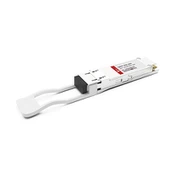
D-NET's 100G QSFP28 LR4 optical transceiver converts four input channels (ch) of electrical data, each operating at 25.78 Gbps to 27.95 Gbps, into four optical signals, and then multiplexes them into a single channel for 100Gb/s optical transmission. Conversely, on the receiver side, the module optically demultiplexes a 100Gb/s input into four signals, each corresponding to one of the four lanes, and converts them back into four lanes of output electrical data. The central wavelengths for these four lanes are 1296 nm, 1300 nm, 1305 nm, and 1309 nm, respectively.
Hot Tags: QSFP28 100G LR4 10KM transceiver module, China QSFP28 100G LR4 10KM transceiver module manufacturers, suppliers, factory, QSFP28-100G-SR4, QSFP28-100G-ZR4, , QSFP28-100G-ER4, QSFP28-100G-SR4, QSFP28-100G-LR4
Absolute Maximum Ratings
|
Parameter |
Symbol |
Min. |
Typical |
Max. |
Unit |
|
Storage Temperature |
TS |
-40 |
+85 |
°C |
|
|
Supply Voltage |
VCCT, R |
-0.5 |
4 |
V |
|
|
Relative Humidity |
RH |
0 |
85 |
% |
Recommended Operating Environment
|
Parameter |
Symbol |
Min. |
Typical |
Max. |
Unit |
|
Case operating Temperature |
TC |
0 |
+70 |
°C |
|
|
Supply Voltage |
VCCT, R |
+3.13 |
3.3 |
+3.47 |
V |
|
Supply Current |
ICC |
1100 |
1500 |
mA |
|
|
Power Dissipation |
PD |
5 |
W |
Electrical Characteristics
(TOP = 0 to 70 °C, VCC = 3.13 to 3.47 Volts)
|
Parameter |
Symbol |
Min |
Typ |
Max |
Unit |
Note |
||
|
Data Rate per Channel |
- |
25.78125 |
Gbps |
|||||
|
27.9525 |
||||||||
|
Power Consumption |
- |
3.6 |
5 |
W |
||||
|
Supply Current |
Icc |
1.1 |
1.5 |
A |
||||
|
Control I/O Voltage-High |
VIH |
2.0 |
Vcc |
V |
||||
|
Control I/O Voltage-Low |
VIL |
0 |
0.7 |
V |
||||
|
Inter-Channel Skew |
TSK |
35 |
Ps |
|||||
|
RESETL Duration |
10 |
Us |
||||||
|
RESETL De-assert time |
100 |
ms |
||||||
|
Power On Time |
100 |
ms |
||||||
|
Transmitter |
||||||||
|
Single Ended Output Voltage Tolerance |
0.3 |
Vcc |
V |
1 |
||||
|
Common mode Voltage Tolerance |
15 |
mV |
||||||
|
Transmit Input Diff Voltage |
VI |
150 |
1200 |
mV |
||||
|
Transmit Input Diff Impedance |
ZIN |
85 |
100 |
115 |
||||
|
Data Dependent Input Jitter |
DDJ |
0.3 |
UI |
|||||
|
Receiver |
||||||||
|
Single Ended Output Voltage Tolerance |
0.3 |
4 |
V |
|||||
|
Rx Output Diff Voltage |
Vo |
370 |
600 |
950 |
mV |
|||
|
Rx Output Rise and Fall Voltage |
Tr/Tf |
35 |
ps |
1 |
||||
|
Total Jitter |
TJ |
0.3 |
UI |
|||||
Notes: 20~80%
Optical Characteristics
(TOP = 0 to 70 °C, VCC = 3.0 to 3.6 Volts)
|
Parameter |
Symbol |
Min |
Typ |
Max |
Unit |
Ref. |
||
|
Transmitter |
||||||||
|
Wavelength Assignment |
L0 |
1294.53 |
1295.56 |
1296.59 |
nm |
|||
|
L1 |
1299.02 |
1300.05 |
1301.09 |
nm |
||||
|
L2 |
1303.54 |
1304.58 |
1305.63 |
nm |
||||
|
L3 |
1308.09 |
1309.14 |
1310.19 |
nm |
||||
|
Side-mode Suppression Ratio |
SMSR |
30 |
- |
- |
dB |
|||
|
Total Average Launch Power |
PT |
-4 |
- |
8.3 |
dBm |
|||
|
Average Launch Power, each Lane |
-4 |
- |
4.5 |
dBm |
||||
|
Difference in Launch Power between any two Lanes (OMA) |
- |
- |
6.5 |
dB |
||||
|
Optical Modulation Amplitude, each Lane |
OMA |
-4 |
4.5 |
dBm |
||||
|
Launch Power in OMA minus Transmitter and Dispersion Penalty (TDP), each Lane |
-4.8 |
- |
dBm |
|||||
|
TDP, each Lane |
TDP |
2.2 |
dB |
|||||
|
Extinction Ratio |
ER |
4 |
- |
- |
dB |
|||
|
Transmitter Eye Mask Definition {X1, X2, X3, Y1, Y2, Y3} |
{0.25, 0.4, 0.45, 0.25, 0.28, 0.4} |
|||||||
|
Optical Return Loss Tolerance |
- |
- |
20 |
dB |
||||
|
Average Launch Power OFF Transmitter, each Lane |
Poff |
-30 |
dBm |
|||||
|
Relative Intensity Noise |
Rin |
-128 |
dB/HZ |
1 |
||||
|
Optical Return Loss Tolerance |
- |
- |
12 |
dB |
||||
|
Receiver |
||||||||
|
Damage Threshold |
THd |
3.3 |
dBm |
1 |
||||
|
Equivalent Sensitivity per Channel |
Rxsens |
-10.6 |
dBm |
1 |
||||
|
Average Power at Receiver Input, each Lane |
R |
-10.6 |
0 |
dBm |
||||
|
RSSI Accuracy |
-2 |
2 |
dB |
|||||
|
Receiver Reflectance |
Rrx |
-26 |
dB |
|||||
|
Receiver Power (OMA), each Lane |
- |
- |
3.5 |
dBm |
||||
|
LOS De-Assert |
LOSD |
-15 |
dBm |
|||||
|
LOS Assert |
LOSA |
-25 |
dBm |
|||||
|
LOS Hysteresis |
LOSH |
0.5 |
dB |
|||||
Notes: 12dB Reflection
Ordering Information
|
Part Number |
Description |
|
QSFP28-LR4 |
QSFP28 LR4 10km optical transceiver with full real- time digital diagnostic monitoring and pull tab |
FAQ
1. What is QSFP28 LR4?
The 100G QSFP28 LR4 optical transceiver converts 4 inputs channels (ch) of 25.78 Gbps to 27.95Gbps electrical data to 4 lanes optical signals, and multiplexes them into a single channel for 100Gb/s optical transmission.
2. What is the difference between SR4 and 100G LR4?
With 100GASE-LR4, each single strand of fiber carries four signals slightly offset from the 1310nm wavelength to avoid interference (SR4 uses 850nm.)
3. How much power does a 100G LR4 consume?
D-NET QSFP28–100G-LR4 is compliant to 100GbASE-LR4 of the IEEE 802.3-2012 Clause 88 standard IEEE 802.3bm CAUI-4 chip to module electrical standard ITU-T G.959.1-2012-02 standard , the maximum power consumption of QSFP28–100G-LR4 is 5 W and its power supply voltage is +4 V.